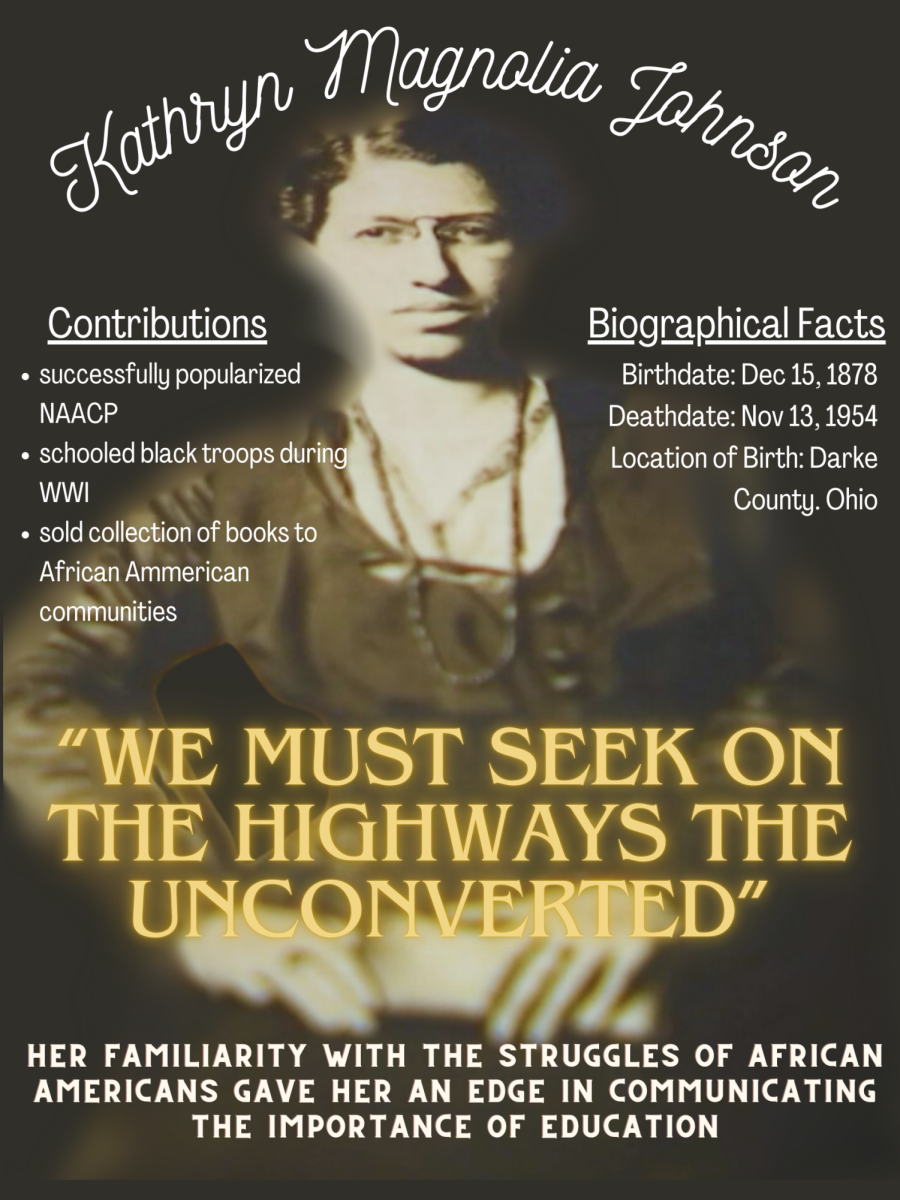
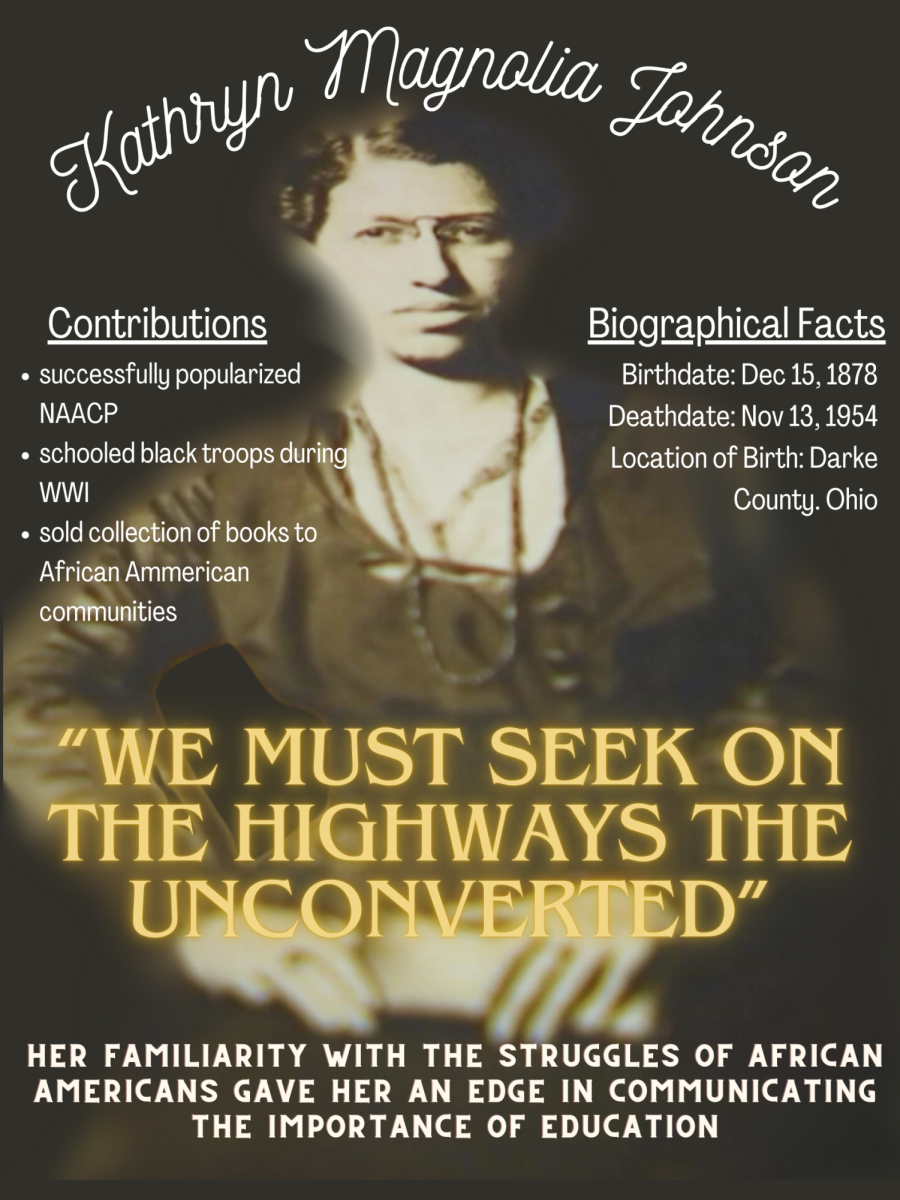
Kathryn Magnolia Johnson dedicated her life to expanding educational opportunities for African Americans and advocating for social justice. Best known for her service during World War I and her work promoting literacy, Johnson played an important role in strengthening African American communities through education.
Born on December 15, 1878, in Darke County, Ohio, Johnson showed early academic promise. She graduated at the top of her high school class in New Paris, Ohio, in 1895 and later earned a bachelor’s degree and teaching certificate in 1902. She went on to teach at several schools, including the State Normal School for Negroes, Shorter College, and Sumner High School, building a career centered on education.
Johnson’s work soon expanded beyond the classroom. While teaching in Kansas City, she became a branch organizer for the National Association for the Advancement of Colored People (NAACP). Although she left the organization in 1916 under unclear circumstances, her advocacy for civil rights continued.
That same year, Johnson joined the Young Men’s Christian Association (YMCA) and traveled to France during World War I. There, she worked with approximately 200,000 African American soldiers serving in segregated U.S. Army units. While overseas, she helped provide educational opportunities to troops who had often been denied access to schooling in the United States.
Johnson later documented these experiences with fellow activist Addie Waites Hunton in the book Two Colored Women with the American Expeditionary Forces. The book offered one of the most detailed accounts of the experiences and treatment of African American soldiers abroad during the war.
After returning to Chicago in 1919, Johnson continued her mission to promote literacy. She helped distribute The Two-Foot Shelf of Negro Literature, a collection of books by Black authors published by historian Carter G. Woodson’s Association for the Study of Negro Life and History. By 1928, Johnson had traveled more than 9,000 miles and sold about 15,000 books, helping bring African American literature to communities across the country.
Throughout her life, Johnson championed literacy, education, and civil rights. Her organizing efforts helped expand the reach of the NAACP, and her advocacy highlighted the importance of education as a tool for empowerment. Though often overlooked in mainstream histories, Johnson’s work laid important groundwork for future civil rights leaders and helped strengthen educational opportunities within African American communities.