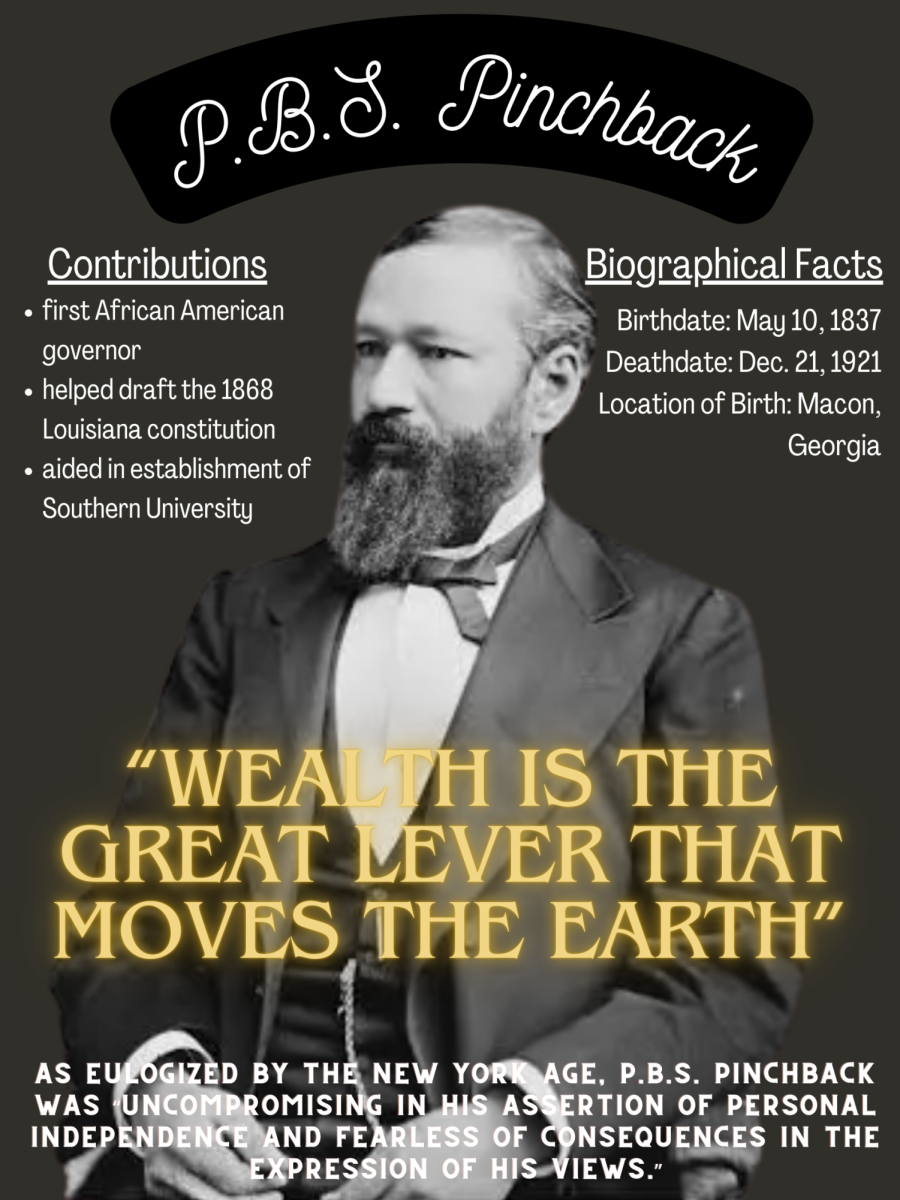
Pinckney Benton Stewart Pinchback made history during the Reconstruction era as the first African American to serve as a U.S. governor. His rise to political power demonstrated how newly freed African Americans began using their civil rights to shape the nation’s future after the Civil War.
Pinchback was born in Mississippi to Major William Pinchback, a white planter, and Eliza, a formerly enslaved woman. Because of his father’s influence, he learned to read and write at a young age. After his father’s death in 1848, however, Pinchback and his family fled to Ohio to avoid being enslaved by his father’s relatives.
As a young man, Pinchback worked as a cabin boy before joining the Union Army during the Civil War. He eventually became captain of Company A but resigned in 1863 after experiencing unequal pay and discrimination in promotions—treatment that many Black soldiers faced at the time.
After the war, Pinchback turned to politics and civil rights activism. In 1867, he began working with members of the Republican Party and soon gained recognition for his advocacy of Black civil rights. After delivering a powerful speech supporting equality, he was elected to Louisiana’s state constitutional convention. There, he helped draft provisions that expanded voting rights for African Americans and restricted the political power of former Confederate soldiers.
Pinchback’s political influence quickly grew. He was elected to the Louisiana State Senate and later became lieutenant governor. When Governor Henry Clay Warmoth was removed from office in 1872 during impeachment proceedings, Pinchback assumed the governorship, becoming the first African American governor in United States history.
His political career, however, unfolded during a violent period. Opposition to Reconstruction policies often led to deadly conflict. In 1866, a white mob attacked a constitutional convention in New Orleans during what is now known as the Mechanics Institute Massacre, leaving dozens of African Americans dead and many others injured. As Pinchback pushed for civil rights legislation, he also received death threats from opponents, including members of the Ku Klux Klan.
Although his leadership was groundbreaking, Pinchback’s achievements were often overlooked for many years. In recent decades, however, efforts have been made to recognize his legacy. In 2020, a historical marker honoring him was unveiled in Alexandria, Louisiana, and the P.B.S. Legacy Award was established in 2021.
Pinchback’s life stands as a powerful example of perseverance during one of the most challenging periods in American history. His accomplishments helped demonstrate that African Americans were determined to claim their rights and participate fully in shaping the country’s political future.